
Within days of announcing mega investments for building in Hyderabad its second data centre cluster in India, Amazon Web Services (AWS) on Monday said it is excited about the India market, where cloud adoption offers massive headroom for growth. Pledging its long-term commitment to the India market, AWS, Amazon's cloud computing unit, said it expects global uncertainties to accelerate the decisions by companies to opt for flexible, on-demand cloud infrastructure to pare costs, gain efficiencies and drive business innovation. "Cloud reacts well to uncertainty," Puneet Chandok, president - commercial business, AWS India and South Asia, Amazon Internet Services Pvt Ltd (AISPL) told PTI.


2013 foreign currency non-resident deposits to mature in Sep-Nov

Since its peak, the S&P BSE Sensex has dropped nearly 3,000 points.

Bond markets, global as well as domestic, are likely headed towards hard times over the next three to six months, as higher vegetable prices, rising fuel costs, and improved wages may keep inflation hot, believe analysts, who expect the yields to hit 7.5 per cent in the near-term from the current 7.234 per cent. In this backdrop, they suggest investors can put in money in funds/instruments with residual maturity of 4 to 6 years, while longer-term investors can allocate cautiously to the longer end in the range beyond 7 years.

Investment experts said the key to generating superior returns was "asset allocation" and taking money out of the table from themes that have performed well and into themes that are available at a discount.

In the 52 newly listed companies since 2014, fund managers have a total investment of a mere 2.5 per cent of their assets under management.

Banking and real estate stocks rise up to 5% on further rate-cut hope.

tailwinds of a remarkable year and handsome investor returns, Indian equities are set for an eventful journey in 2024, with a slew of local and global cues -- varying from interest rates to Lok Sabha polls to geopolitical happenings. Analysts are of the view that the bull run in the domestic equity market will continue, and over the next 3-6 months, the benchmark indices -- Sensex and Nifty -- could climb up to 7 per cent. In 2023, the 30-share BSE Sensex jumped 11,399.52 points or 18.73 per cent, and the NSE Nifty climbed 3,626.1 points or 20 per cent.

There is polarisation among sectors with IT and healthcare receiving the lion's share of FPI money in the past two quarters.

Banks have taken this aggressive posture even as liquidity has become comfortable on the back of increased government spending.

As many as 267 of 453 companies from the BSE500 index are trading above their consensus price targets, according to the data compiled by Bloomberg. Not all companies in the BSE500 index are tracked by analysts.

RBI has cited at least 10 areas where it has no control over PSBs.

Benchmark indices gain 30% this year, buoyed by global liquidity, new government

Persistent capital inflows by domestic institutional investors and retail investors kept the markets in fine nick

Bonuses are typically commensurate with deal activity in any given year. Investment banks, on average, pocket 2-3 per cent as fees for managing an IPO and 1.5-2 per cent for handling QIPs.

Mutual funds have ratcheted up Rs 53,700 crore (Rs 537 billion) through new fund offers (NFOs) in 2022 until November, against Rs 1 trillion in Calendar 2021, notwithstanding the number of launches this year eclipsing the 2021 tally. Industry insiders cite the absence of launches in popular categories as the reason behind lower collections this year. Typically, only NFOs in popular categories from major fund houses rake in the moolah.

Markets shrugged off RBI's neutral stance on key policy rates.

Unified Payments Interface launched to simplify mobile banking.

The central government's deposits with the RBI had fallen to just Rs 100 crore as of June 8.

The NITI Aayog may want us to believe this is one of the easiest payment systems in the world, but Tinesh Bhasin decodes the many unanswered queries and concerns involving the United Payments Interface.

60-plus men and women who live independent lives are becoming the cynosure of ad men's eyes.

Financial shares were the top losers.

Gains were led by index heavyweights Reliance Industries and Infosys.

India's five leading wilful defaulters are Winsome Diamonds & Jewellery Ltd and associate Forever Precious Jewellery & Diamonds, Zoom Developers, Kingfisher Airlines, Beta Naphthol and Raza Textiles

Customers can link their cards to banks' app and make payments after scanning a 'quick response' code.

Pharma shares extended losses after the government's ban on combination drugs.

Asian markets were trading mixed with shares in China witnessing profit taking after sharp gains in the previous session.

Relations with the government, the bank's majority owner, are a tricky issue for all SBI chiefs, and, like all his predecessors, Khara will be closely watched for his equations with the finance ministry representative on the SBI board.

Experts feel select companies in banking, automobiles, financial services & real estate will gain from lower interest rates

CEOs of leading banks say third straight rate hike by RBI inevitable, though not desirable.

The fuel reforms are a very important signal of the government's commitment to tough economic reforms.

Focus on large-caps and ensure that the portfolio is balanced.

However, RIL has exceeded the mandatory 2% prescribed limit, spending the maximum amount of Rs 761 crore

All sectoral indices, led by realty, PSU, oil & gas and banking, were in positive zone with gains of up to 1.25 per cent.

Infosys, TCS, HUL and Reliance Industries were the top gainers of the day.

RBI has, since January, cut its policy rate four times.
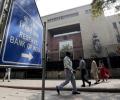
However, RBI would continue to nudge banks to cut lending rates

The broader markets are trading inline with the larger peers with BSE Midcap and Smallcap indices up 1.5% each.

Retail investors have gained significant heft in the past year amid a sustained uptick in Indian equities. The share of retail investors in companies listed on the NSE reached an all-time high of 7.32 per cent in the quarter ended December 31, 2021, up from 7.13 per cent in the previous quarter and 6.9 per cent a year ago, the data from PRIME Infobase shows. This was despite the Nifty's 1.5 per cent decline during the quarter.
